Ingmar Bergman’s Persona is up to interpretation for anyone who watches it. Released in the 1960s, it’s one of the most talked about films of the last century. The word “persona” means mask in Latin. It is, as Carl Jung describes, “a kind of mask, designed on the one hand to make a definite impression upon others, and on the other to conceal the true nature of the individual.” In their private life, a person takes off the mask they wear outside and wear a more intimate mask. It’s like a raging politician coming home to be a tender father to his children. When a person confuses their “persona” with their identity, they can often feel disconnected from their true self. It is supposed to be a tool, not a definition of one’s “self”.
The main narrative of the film is that Nurse Alma treats Elisabet Vogler, who’s silent, but doctors have said that she doesn’t seem mentally ill, and she’s just silent out of pure will. Throughout the “treatment”, Alma starts confessing her secrets, including relevant information from her past. Though no matter what Alma says, Elisabet just listens; she doesn’t say anything.
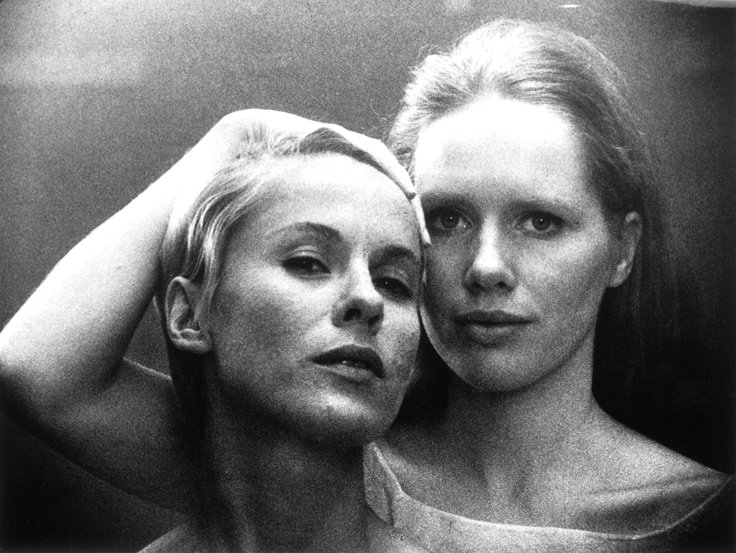
As the film progresses, Elisabet and Alma seem to resemble each other. The merging of the outlines of the characters represents that identity is not a fixed concept. We are shaped by our environment, from who listens to us, talks to us, and who ever even slightly affects us. The film suggests that our “sense of self” may be more breakable than we believe.
At the end of the film, a film crew appears with a large movie camera. I think all of this is to remind us that we’re watching a movie. Alma and Elisabet keep breaking the fourth wall; it adds to the “instability of the identities” in Persona.
There is a lot of ambiguity presented in the story, especially when there’s a lot of uncertainty over Alma and Elisabet. We don’t know who’s the nurse or who’s the patient. We don’t know who’s actually the performer. Even when there is a confrontation over Elisabet’s situation with her son, the scene is being shown from both perspectives, and it is left unclear whether Alma is uncovering the truth of Elisabet or is projecting how she feels. Are they the same people? Two separate people? Part of the same conscience?
More of the uncertainty in some of the scenes includes Elisabet randomly speaking to Alma when she’s asleep, or Elisabet’s supposed husband visiting; we don’t know if this is real or not, we don’t know if it actually happened, or happened due to imagination.
Overall, the ambiguity allows viewers to project their varied interpretations of this film, therefore enhancing several discussions not only on the film itself, but also the psychology of it, as it talks about one of the most disputed psychological concepts of all time, “identity”.
My interpretation is that Elisabet and Alma are two halves of the same person. I think this is the case because the close-up to their faces merging suggests that there is an identity overlap. There are also a lot of scenes where Alma reveals personal experiences to Elisabet, and Elisabet is just silent, which I interpreted as Alma talking to herself. I also think Elisabet represents Alma’s subconscious because Elisabet doesn’t talk directly; she’s almost hidden in a way, but is still influential to Alma.
To this day, Persona still feels so much more relevant. It talks about performance, who we are without the public eye, and who we are with it. This film is a deep exploration of the human condition, and it makes you think more about yourself and what your relationship is with your “persona”.


 The Film Reel
Leave a comment